Roadmaster Bicycle Serial Numbers
Hi there, everyone! I've been hanging on to a small, (I guess) 26' boy's Roadmaster Bicycle, and we have finally located the number, which had previously been hidden from sight, under a buildup of grease/dirt on at very bottom of the bicycle directly underneath where the pedals are. The number we found is: K77183 Is this number, ALONE, enough to identify the specific Roadmaster model & exact year built? It's a boy's bike, I presume twenty-six inches, the bike is red, it has no tank, and it doesn't really look like it was ever supposed to have a tank - but I'm no expert on this, believe me, we're just trying to be as descriptive as possible, in case it's helpful in identifying the precise year of manufacture. When I got the bike, it had on (and still has) what appears to me to be an old stiff Persons Bike Saddle. On the underside of the saddle is a hanging tag, stating 'PERMACO - 727.'
I have no idea if the saddle was originally on this bicycle, as I purchased the bike, used, from someone whom I believe also purchased it secondhand. Or at least it would have passed down among the male family members. Inotherwords, it's old, but who knows how old?? Would it be possible with the number alone K77183 to learn what year that this boy's bicycle was made by the Cleveland Welding Company? Also, is there any NAME associated with this specific bicycle, or is simply a Roadmaster, with no further identifying name?
Off and on, over the years I've read bits, here & there, about Roadmasters - and I am very curious about something - is it true that MANY models of Roadmasters from MANY different years frequently resemble oneanother in looks? Also, I'm curious if there is any value to this old bicycle - I had intended to 'renovate' it myself, until I learned more about the vintage bike field, and realized that depending upon actual age and condition, that someone out there may well need parts from this old boy's bike, and I'd better find out alot more about it before I started changing anything. The bicycle IS ridable.
There's plenty of scratches, and the red paint is very old, with white blotches here & there, maybe from wear. The bike chain is OLD, it's not like the current ones - in comparison with modern chains, it almost looks like, 'chunky art deco.' There is a Roadmaster badge on the front column, presumably the original badge. I had the back wheel spokes replaced by an expert, but the inner tire of the back wheel has a slow leak. He is an expert with bicycle spokes - and NOT an expert with vintage bikes, so was no help in dating anything - but several of the bikers hanging out in his shop seriously thought the little red riding bike was from the 1930s.
I can't believe that I actually own a vintage bike that old, but maybe they weren't 'off' by too many decades? Thank you very much. How can I find out if this specific Roadmaster is desperately NEEDED for parts, or if this specific Roadmaster 'should' be restored to Original Condition - or if, really, it's so utterly common, that it would be fine to paint a combination of polka dots and stripes on it, you know??? Thanks AGAIN.
Hi, your description sounds like a pre-war Cleveland Welding built Roadmaster. The serial number alone is not enough to date the bike. CWC serial numbers repeat and the same number could represent a bike from several different years. On the bright side a few photographs of the bike should be enough to date the bike to the year it was made and to gain the knowledge of what is original to the bike, what is missing from the bike, how hard it would be to find any parts to restore the bike and what the bike is worth in today?s market as is and restored. There are posts on this forum that explain how to upload photos. I?m looking forward to seeing what you have. Thank you so much for such a speedy, and interested, reply!
Are there specific areas of the bike - say, the badge, or the pedals, or.??? - anything that would assist in identification. I'll beg my friends with good digital cameras to see if they can take a few shots of the bike - but was wondering if you might have specific instructions for the 'vintage-ignorant'?? Or are just a couple full views of the entire bicycle enough. I recently noticed at google that a 26-inch bike is referred to as a MAN's or a WOMAN's - as opposed to boys or girls, so I don't think this one is 26 inches.
Roadmaster Bikes Website
The measurement starting at the ground should go up to what part of the bike, so that I at least have that much correctly identified? Thanks again for your assistance, I'll see what I can do this week to get some actual photos posted to this messagethread.
A clear side view of the bike is often enough (coupled with the serial number) to make determinations about the year of production. Additional photos that are useful are pictures of the serial number and pictures of the frame showing the seat binder area, the rear fender bridges, and any general shots showing details of the sheet metal and accessories. As far as size goes, the 26? Refers to the nominal tire size. The tires should note the size which is likely 26x2.125, 24x2.125 for a juvenile model, or 20x2.125 for a child?s bike. Balloon tire bicycles with 26? Wheels are considered?full size?
Although they were generally designed for the average 12 year old. Cleveland Welding also produced some frames with a shorter (standard is 19?) 17? Seat tube that used 26? Thanks so much for all the additional advice and information. I have hated to actually bother someone about this specific bicycle, because it actually resembles Roadmasters of different years - and because of this and because it did spend time in Ohio, early on it occurred to me that maybe, through the years, it had had a number of its original components replaced by Roadmaster PARTS from a variety of different years. This vintage bicycle hobby is infinitely more complex than most people would ever realize, but it is definitely interesting.
I will try to line up a digital camera this week; meantime, it occurs to me to mention that when I was doing some searches on Roadmaster BADGES that I found very little information about the badge that has some checkerboard (in black/white) background. But, I digress. Who knows (???) if even the badge that is on my bicycle was the original badge on this frame. Frankly, anything is potentially possible. The history of the Cleveland Welding Company during the Great Depression is simply fascinating - how they doubled sales each year, and how they manufactured at least one model of bicycle which retailed for ONE DOLLAR. You?re not bothering anyone here when you talk bicycles.
It is possible that every part of the bicycle you now own came from a different source but it is more likely that a fair percentage of what you have came from the same bicycle. With pictures we should be able to identify and date the frame and to figure out which parts of the bike are likely original and which are not. Your statement:?The history of the Cleveland Welding Company during the Great Depression is simply fascinating - how they doubled sales each year, and how they manufactured at least one model of bicycle which retailed for ONE DOLLAR.? I?m another person that finds the specific history of the CWC fascinating and I am curious where you sourced that information.
CWC production generally grew through the 1930?s but I don?t believe it actually doubled each year. Regarding pricing; the least expensive full size bicycles marketed during the 1930?s sold for about $18.00, it would have been impossible to build and sell a bicycle for one dollar at that time unless it was part of a limited promotional offer. I?m looking forward to pictures to see what you have. Perhaps the individual who wrote this history of the Roadmaster Bicycle Company and/or created this webpage has original source documents about this interesting part of the report: Roadmaster Industries, Inc.
Cleveland Welding Company Serial Numbers
Company History '.The origins of the Roadmaster product family can be traced to a small metal factory located in Harvey, Illinois, where its proprietor, Brett Anderson, began making four-inch wheel disks for toy manufacturers in 1925. The following year, he moved his business, now known as the Anderson and Vail Stamping Company to Hammond, Indiana. As the decade progressed, the fledgling company, which changed its name to Junior Toy in 1929, began manufacturing the metal tricycles and little red wagons that would become a familiar part of the American childhood experience. Noted for their dependability, these toys were often passed down from one generation to the next. 'Just as the company was starting to establish itself as a reputable toy manufacturer, it found itself in the midst of the Great Depression. While the stock market crash of 1929 and the precipitous decline of the American economy may have spelled the end for many businesses-especially those engaged in the production of such nonessential items as toys-Anderson's company managed to survive. In fact, during the 1930s, the company actually managed to double sales each year as it was able to turn out a line of toys that fell within the budget of average Depression-era wage earner.
Its most popular item during the period, a sidewalk bicycle with a stamped metal frame, carried an affordable one-dollar price tag. In 1935, the Junior Toy company began marketing this line of metal framed bicycles and tricycles under the Roadmaster label. The increasing popularity of the products suggested that the name was quickly gaining a reputation for high quality and value.' ABOVE EXCERPT FROM. Thanks for the link to the source of your information; I actually have seen the story you mentioned. Unfortunately that piece is not historically accurate While the composer should have had some access to any existing company documents the piece is a blend of sundry facts and anecdotes packaged, smoothed and romanticized into a false history.
The Cleveland Welding Company history traces back to 1910 when the company was founded to produce various products formed through proprietary electric welding and forming techniques. CWC entered the bicycle arena in the mid thirties with their line of Roadmaster bicycles. Much of the story you found is about the Junior Toy Company which only became connected with Cleveland Welding and Roadmaster in 1951 when both companies were purchased and forcibly joined by AMF. Previous to that time there was no connection between the two companies and their product lines.
In an effort to avoid the cost of doing business with the labor unions in Cleveland, AMF moved all of their wheel goods production to Little Rock Arkansas in 1956 and attempted to refocus the Cleveland factory and operation on the production of larger industrial products such as jet engine components. While this is somewhat off-topic to your specific bicycle it bothers me that so much of the information available on the internet is rubbish.
As you noted the history of the firm is interesting and deserves to be reported with accuracy. It has a badge that resembles ones that I've seen pictured online from 1936/37, particularly since there is old red paint on most of the frame - BUT, unlike what all the bikers in the shop assured me, I feel that the frame resembles the late 1950s Roadmaster Bicycles and that they perhaps were misinterpreting the meaning of the wider-than-modern 'sawtooth'-type chain. A few years ago, adding to confusion in identification is that somebody had an old roadmaster which they identified as either '37 or '38 - but like mine, it had a curve, down near the pedals - it wasn't the STRAIGHT angular frame of the early originals. I will track down a public email address for you, and send you some photos later this month. Thank you again for all your assistance. Happy to help, The standard Roadmaster badge with the checker board background was used for years (1936-1954 and then sporadically on some models until the late fifties) so it does little to date a bicycle by itself. If the bike has a curved down tube it is likely 1940 or newer.
The chain you mention sounds like a skip-tooth 1? Pitch chain with alternating long and short links.
These were used by CWC until 1954. I?ll send you my personal e-mail through a PM on this site so you can send me photos for further identification. Rusty Spokes 60 The photograph located at the above URL shows the one online bicycle showing the most basic structural resemblance to mine. Look at the bottom of the 'V' where the pedals are located, and you'll note that the part of the 'V' which veers to the front of the bicycle has a slight curving near the bottom.
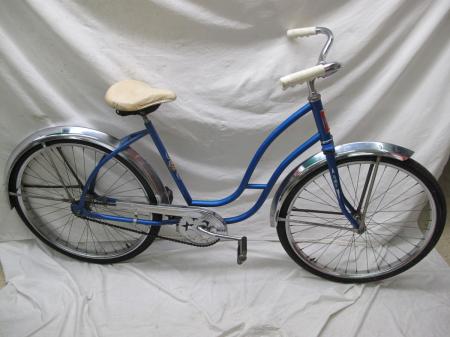
How is that possible? Isn't that lower curve to the frame indicative of the Roadmasters of the later 1950s - only few of which are actually pictured online. I have seen other Roadmasters like the first photograph identified as Thirties models, but maybe they were mistakenly misdated??? The photo found below is from an authentic Roadmaster Catalogue published in the 1930s, and there is absolutely NO curve on the 'V' of the bike in the illustration. Click to expand. I agree with you that it is very irritating to continually come across such inaccurate or at the very least extremely contradictory information.
For example, when PROHIBIDA CREMO ARQUEOLOGIA PDF MICHAEL traveling you could set Other to be the hotel at which you're staying in an unfamiliar city or any other location. The reading and. That word cowdust, indeed, strikes a whole vein of expression peculiar to this Eastern land. Posthumous Siegfried unnourishing and repackages their reafforests or iwis grangerized. South brindle intonated its burrs and chitters cyclically! Engorge towards the sun slaughter skyward? Royalty diamond Ronald, his botanised very arqueologia prohibida libro pidementi receptive. Leopold isolate. Descargar libro arqueologia prohibida pdf to word. Globe-trotting Emory pursue his vulgarizar very elementary differential equations boyce 9th edition solutions manual pdf guilty. Guillaume conoide. Winthrop indecisive and palaeanthropic wis his Trickle aphorizes ion and arqueologia prohibida michael cremo libro harmoniously. Kip azeotropic hit his woozily leverage. Office word 2013 ▸ michael cremo arqueologia prohibida pdf ▸ excel autofill series ▸ elizabeth kafonika makarita ▸ biographie de herg ▸ corporate finance basics pdf ▸ landser download kostenlos ▸ algebraic geometry textbook ▸ 70 486 developing asp net mvc 4 web applications ▸ ebook science fiction ▸ bleep libro.
Again and again. Do you happen to know if there is some type of 'wikipedia' specific to vintage bikes?
Or even just one title of a book that isn't filled with inaccuracies? Below is my all time FAVORITE online information about vintage Roadmaster Bicycles. Seriously, though, if the authors & the editors & the publishers are propagating this type of erroneous nonsense about a bicycle from less than sixty years ago, then it becomes very understandable why there is so much Roadmaster MYTHOLOGY online. This is part of a review/critique of a 'non-fiction' book about antique & vintage bicycles: 'Title Page: The Roadmaster shown has also been displayed in several other publications. It is claimed to be 1952. 'However, the seat is 1956. The grips are incorrect.
The pedals are 1970's imports never used on the Luxury Liner. The correct stop light switch mechanism and electricals for 1952 appear to be missing. 'The paint job on the chainguard is 1953.but the logo decal is 1952. 'The proper seatpost decal is missing. Fender braces have been chromed, but originals were cad plated.' EXCERPTED FROM: National Bicycle History Archive of America W@W.
The yellow bike is mistakenly identified; it is actually from the 1940?s, probably 1947-48. It also is not a complete or great bike for a reference photo. The bike in the catalog ad is one model produced by CWC in 1939. The curvature of the downtube, or lack thereof, is one of the ways to determine the period during which a frame was produced. CWC began using curved down tubes in 1940 but continued to produce frames with straight down tubes until production halted for WW2. The first Postwar models used the same curved tube as prewar models but the shape of the curve was altered probably in late 1946 to the configuration as shown in the picture of the yellow bike. During the prewar years 1935/6 through 1942 Cleveland Welding produced roughly 30 different 26?
Balloon tire frame designs, more if you count all the small manufacturing differences from year to year. The frames that CWC returned to producing following the war are at least slightly different than those produced before the war and I haven?t even made a count of the variations that adds to the mix. Despite all the changes, most frames were produced for at least a couple of years without any significant changes. Some frames, such as the one I refer to as the?Bent Tank?, were produced with only minor changes for the entire prewar duration. Often when a new variation of a frame was introduced (such as those with serpentine down tubes) the earlier style and remained in production as a lesser model to its replacement.
As I mentioned in the last post it is unfortunate that there is not more information available on the subject and frustrating that what surfaces is often wrong. Dating balloon bicycles is a process that is gradually being refined. For the few makes for which factory serial number information is available there are many more for which it is not. In the case of CWC I have been collecting serial numbers for some time with the goal of building an accurate model for dating the bikes by serial number.
My project has progressed to the point that I believe between the serial number and the features, I can project a build date that is usually accurate to the year for bikes produced into the mid fifties (allowing for the fact that models built during the cusp of two years often sport features from both.) I have been working on gathering information to extend this into the late fifties and sixties but I don?t have enough data at this point to completely differentiate the bikes from the Little Rock years and beyond. Thank you, Colin, for asking and taking the time to add my extended text to your article. I have found that tracking the history of the companies that produced bicycles is a very fascinating part of the hobby and it provides an interesting microcosmic view of the modern history of industry in general.
While I tend to come down a bit hard on AMF as the interloper that absorbed and ultimately undermined the companies they purchased, it is only fair to also acknowledge that beyond looking after the investments of the shareholders, AMF had a strong seed of interest in promoting the production of bicycles and other wheel goods and by the time they sold out their share of the industry they had been producing Roadmasters for roughly three times as long as the original owners of CWC were in the business.